This second monthly short text is extracted from Chapter 1. NOTIONS OF EXOTICISM, which explores the evolution and theoretical structure of exoticism, tracing its journey from ancient Greek roots to modern-day discourse. By examining various scholars like Victor Segalen, Jean Baudrillard, Tzvetan Todorov, Paul Morand, Francis Affergan, Cécile Borie, Jean-François Staszak, etc. Mazzalovo highlights how exoticism is a subjective point of view rather than an inherent quality of an object.
A brief semantic history
The adjective "exotic" formally entered French literature in 1552 through François Rabelais in The Quart Livre (1552, final edition) to describe marvels, merchandise, and foreign animals. It appeared in English in 1599 via Ben Jonson in Every Man in his humor to describe magic and witchcraft. The term experienced a massive boom in the 19th century, driven by colonialism, tourism, and a maturing "exotic awareness" in art and literature, adopting associations with mystery, danger, nostalgia, and eccentricity. However, by the 20th century, the concept suffered from a critical view of colonization, trivialization due to commercialized tourism, and tropical clichés. In the 21st century, "exoticism" is often viewed as an old-fashioned or even degrading discourse, largely replaced by the more positive and flexible concept of diversity. It has become an old word of an old world.
The Production Process of Exoticism
Exoticism is fundamentally rooted in the concept of an "outside", which implies an "inside" reference point (a Base) and a distance or difference between the two. Dictionaries generally offer two distinct types of definition: the objective characteristics of foreignness, and the subjective "taste"; or attraction for the strange. A four-phase process structures the production of the exoticism phenomenon.
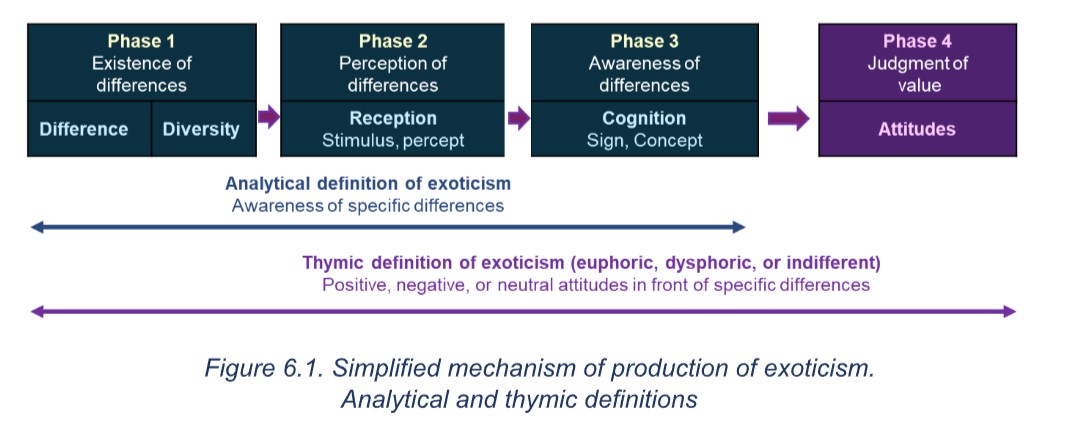
The generation of exoticism happens sequentially in four distinct phases:
- Existence: The actual presence of differences that feed global diversity.
- Perception: An individual perceives stimuli related to these differences but does not yet
understand them.
- Cognition (The Sign): Stimuli are decoded and recognized as differences. This recognition relies heavily on the observer's Base which is his own ordinary, familiar, everyday cultural environment and memory. Exoticism is induced when a difference contradicts this established Base.
- Judgment: The individual applies value judgments to these decoded differences. This thymic judgment takes three forms:
- Euphoric (Positive): A favorable attraction to the different. This is championed by authors like Victor Segalen, who defined exoticism as the "Aesthetics of the Diverse" and celebrated the "eternal pleasure of sensing Diversity". and Paul Morand, who noted the charm and virginity of the "Elsewhere".
- Dysphoric (Negative): A reaction of disgust, fear, or rejection of the foreign. This is the case of all types of racism. A literary example is the famous first sentence by anthropologist Claude Lévi-Strauss in Tristes Tropiques (Terre humaine 1955): “I hate travel and explorers”.
- Aphoric (Neutral): An indifferent or purely sociological or scientific observation. Philosopher Jean Baudrillard exemplifies this by noting the "irreducible foreignness and eternal incomprehensibility” of different cultures without assigning positive or negative judgment.
From this process, we can derive two definitions:
- The Analytical Definition: The awareness of differences. This views exoticism simply as
the perception of the property of an entity belonging to a foreign, or distant context. It stops at the cognitive recognition of specific differences without applying a value judgment.
- The Thymic Definition: A judgment on the awareness of specific differences. This
defines exoticism as a subjective judgment, attitude, or "taste" regarding those recognized differences. As geographer Jean-François Staszak argues, exoticism is never an inherent property of an object, but rather a subjective point of view, a discourse, and a set of values proposed by an observer.
Endoticism: The Ethics and Aesthetics of Sameness
To fully grasp exoticism, one must also understand its conceptual opposite: endoticism. Coined by French writer Georges Perec, endoticism focuses away from the foreign and toward the ordinary, mundane, and familiar aspects of one's own culture. While exoticism relies on the perception of differences, endoticism is the acute perception and judgment on similarities. Its production mechanism exactly mirrors exoticism's four phases, substituting the perception of differences with the perception of similarities. The thymic definition of endoticism parallels the one given on exoticism: a judgment (or attitude) on the awareness of specific similarities.
Mimesis vs Transgression
Both exoticism and endoticism are powerful intertwined forces generating consumers’ desire and social behavior, driving social actions like mimesis and transgression:
- Mimesis occurs when people emulate others, their desire being triggered by the envy of others’ consumption. This battle for prestige follows two basic motivations: being like others or eliminating one’s envy. Girard (1977) is the most influential author of the mimetic theory. The wish for social recognition is stronger than the appeal of the object of consumption. Mimesis consumption motivation is a strong demonstration of endoticism.
- On the other hand, exoticism drives transgression, the desire to break taboos, affirm original identity, and stand apart from the collective. It occurs when individuals break social interdictions. Bataille (1967) 2 is the main author who theorized the consumption behavior of 1 GIRARD René (1977), Violence and the Sacred, Baltimore: Johns Hopkins University Press. constructive transgression. He maintains that society is constituted by its interdictions, which are meant to control the violence inherent to the process of sharing life space. The transgression of these interdictions and taboos helps raise the individual above the collectivity, affirm his original identity, and can be achieved through transgressive consumption. This type of motivation is a strong manifestation of exoticism.
Semiotic square of Mimesis vs Transgression
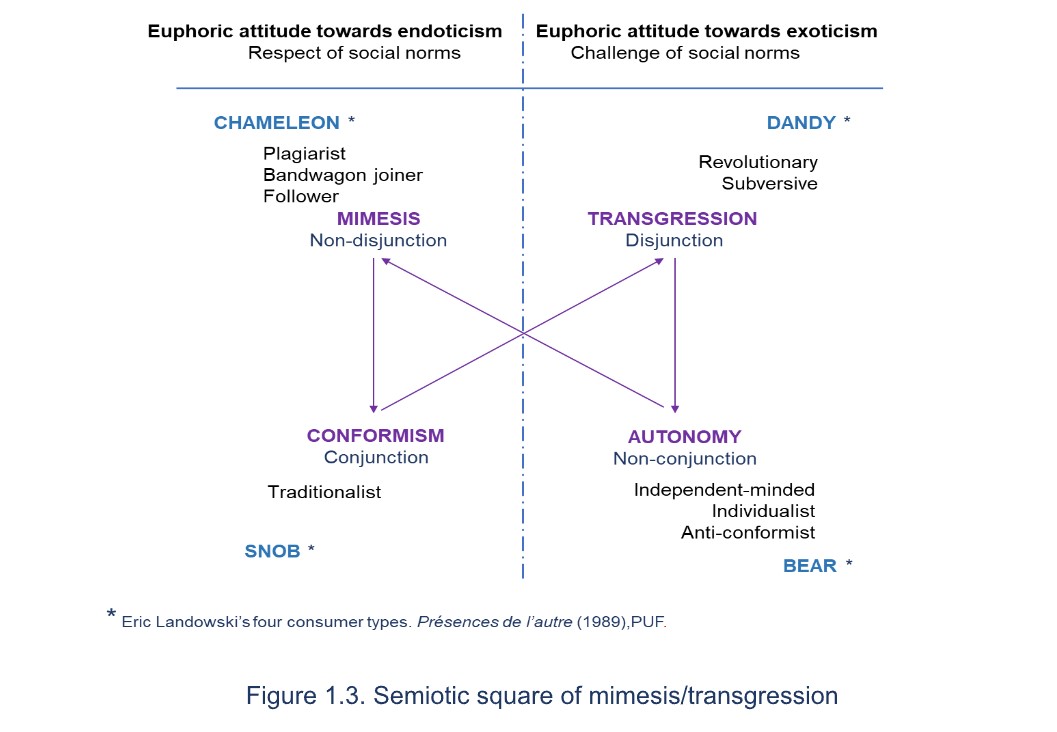
We can position the two behaviors on a tentative semiotic square where the semantic axis, mimesis vs. transgression, corresponds respectively to the traditional non-disjunction and disjunction positions (see Figure 1.3). On the contradiction axis of Mimesis, Autonomy characterizes the absence of it. This corresponds to the behavior of an independent-minded, individualist, and anti-conformist individual, whom Landowski (1997) called the Bear in his classification of the four consumer types 3 based on their attitudes toward consumption and social interaction. The contradiction axis of Transgression is Conformism, which can be related to Landowski’s Snob type, who anticipates everybody in the coming fashion trend. The Chameleon type corresponds to the mimesis behavior, while the Dandy transgresses.
More being said in Chapter 3, Part C (Differences and Similarities).
1 GIRARD René (1977), Violence and the Sacred, Baltimore: Johns Hopkins University Press.
2 BATAILLE Georges ([1949] 1967), La part maudite, Paris : Editions de Minuit.
3 LANDOWSKI Éric (1997). Présence de l’Autre. Presses Universitaires de France.